
A New 2025 Study Proves The Significance of Trauma - What This Means For Groomers
- Stephanie Zikmann

- Oct 4, 2025
- 6 min read
We've all heard someone dismiss another person's struggles with a casual, "Well, it could have been a lot worse" or "That's nothing compared to what I've gone through". It's a peculiarly human tendency to rank suffering, as though trauma operates on some sort of universal scale where only the most horrific experiences qualify for acknowledgement. But trauma doesn't work that way at all. Not for us, and certainly not for our dogs.
Recent groundbreaking research from Dr Julia Epinosa and her team has given the entire dog care community something we desperately needed - hard evidence that what happens to dogs, particularly early in life, matters profoundly, and that the effects ripple outwards for years, if not the entire lifespan of an animal (Epinosa et al., 2025). Their study of 4,500 rescue dogs revealed that early life trauma significantly increases the likelihood of fear and aggression in later years, with adverse experiences during the first six months proving to be the most significant predictor of future behavioural challenges.
The Science of Early Adversity
Dr Epinosa's research joins a growing body of evidence demonstrating that dogs, like humans, are profoundly shaped by their early experiences.
Considering what we know about mammalian neurodevelopment, this is not really too surprising. During early life, the brain is extraordinarily plastic - constantly forming neural pathways based on experience. In humans, we've known for decades that adverse childhood experiences (ACEs) predict everything from mental health challenges to physical illness in adulthood (Felitti et al., 1998). The same principles apply to our canine companions.
Research by Tira and Lohi (2015) demonstrated that fearfulness in dogs has both genetic and environmental components, with early experiences playing a crucial role in whether a genetic predisposition manifests as clinical fear. Similarly, studies on canine stress responses have shown that repeated exposure to stressful situations without adequate coping mechanisms can lead to learned helplessness and chronic anxiety (Seligman, 1972; Beerda et al., 1999).
But Surely Grooming Sessions Can't Cause Significant Trauma?
Here's where we need to talk about relativity. When we think of trauma, particularly in the context of rescue dogs, we often picture neglect, abuse, and abandonment - the obvious contributory factors. And yes, these scenarios would constitute as significant traumatic experiences for sure.
But trauma isn't defined by how it looks from the outside; it's defined by how it's experienced on the inside.


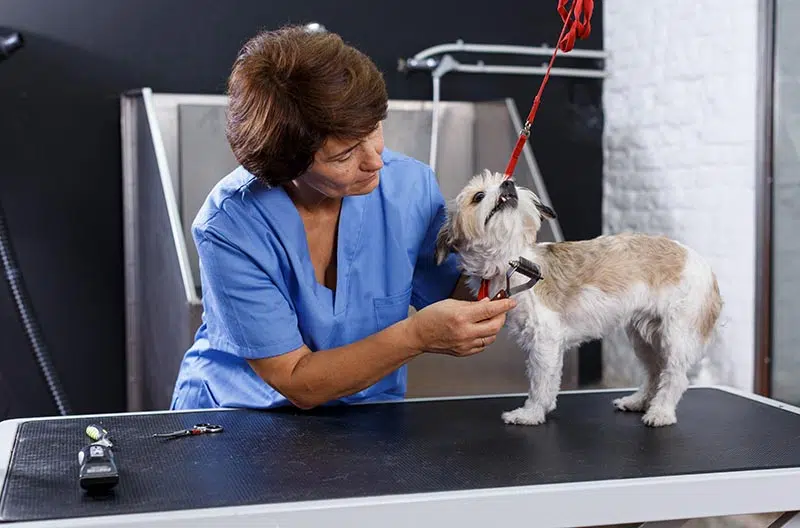
Exercise:
Imagine you were a six-month-old puppy. You've never been restrained on a table before. You've never heard the high-pitched whine of clippers near your face. You've never had a stranger hold your paws whilst sharp scissors snip around your sensitive paw pads. You don't understand why your person has left you with this unfamiliar human in this strange-smelling, over-stimulating place. You try to communicate your fear - pulling away, whale eye, maybe progressing to a warning growl - but the grooming continues anyway, and the handling becomes more and more firm.
From a human perspective, this may be considered "just grooming" but from the puppy's perspective, this is a genuinely frightening experience where their communication is being ignored and their right to feel safe, being totally violated.
Research into canine cognition and emotional processing tells us that dogs experience fear, anxiety, and stress in ways that are neurologically similar to humans (Berns et al., 2012). When a dog is overwhelmed during grooming, their stress response system activates:
cortisol floods their system
heart rate increases
hypervigilance kicks in
And their brain encodes this experience as a dangerous situation to avoid at any cost going forward (Dreschel, 2010).
The Grooming Salon as a Critical Touchpoint
What makes this particularly significant for groomers is timing. Most puppies have their first professional grooming experience somewhere between 12 and 16 weeks of age - smack in the middle of that critical six-month window that Dr Epinosa's research identified as most influential (Espinosa et al., 2025).
We are, quite literally, shaping these dogs' future relationship with:
grooming
handling
interacting with strangers
building resilience
Despite Epinosa's research focusing on rescue dogs specifically, I believe the problem with trauma applies to all dogs, and that the grooming experience could, quite literally, be contributing to the various behavioural issues society is faced with today.
The Duty of Care
There's a concept in human trauma therapy called "small-t-trauma" - experiences that might not seem catastrophic but nonetheless overwhelm an individual's capacity to cope, leaving lasting impacts. It's a useful framework for thinking about grooming and dogs.
A single negative grooming experience might not create a deeply traumatised dog (though it certainly can, and has many times), but repeated experiences where a dog feels scared, unheard, and powerless? That's a pattern. That's conditioning. That's how we create dogs who need sedation for nail trims, who bite as soon as they see clippers, who spend their entire grooming session in a state of learned helplessness.
The research is unequivical: early adverse experiences shape behavioural outcomes.
We can no longer pretend that "getting the job done" is sufficient.
We can no longer dismiss a dog's fear responses as "just being dramatic".
We can no longer prioritise efficiency and aesthetics, over emotional welfare and wellbeing.
Studies on cooperative care and low-stress handling demonstrate that alternative approaches aren't just kinder, they're more effective (Yin, 2009). Dogs who are given agency, who are allowed to communicae, who learn that grooming involves collaboration rather than coercion, show significantly lower stress markers and better long-term outcomes.
Changing the Narrative
Here's what I would like every groomer to understand: you are not "just grooming" dogs. You are potentially preventing or creating trauma. You are shaping neural pathways whether you think you are, or not. You are teaching dogs whether the world is safe or dangerous, whether their communication matters, whether they have any control over what happens to their bodies - and all of that is absolutely significant.
That's not hyperbole. That's neuroscience.
The traditional grooming model - restrain, proceed regardless of distress, prioritise speed and aesthetic outcome - was built on ignorance and outdated theory. We didn't know what we now know about canine cognition, stress physiology, and the long-term impacts of early adverse experiences. But we know now.
Dr Epinosa's research gives us the evidence we need. The decades of research into canine behaviour, stress, and learning give us the framework. The growing body of work on cooperative care and consent-based methods gives us the practical tools (Yin, 2009; Chiandetti et al., 2016).
We have everything we need to do better. The only question left is: will we choose to do better, or will we carry on pretending to be ignorant just so we don't have to change our approach?
Moving Forward
Changing how we approach grooming isn't about being "soft" or a "snowflake" as a certain someone once publicly called me! It's about being evidence-based, competent, and recognising that trauma is absolutely a risk if we don't push ourselves to evolve.
Every grooming appointment is an opportunity. An opportunity to:
build confidence rather than fear
teach cooperation rather than helplessness
contribute to the enhancement of a dog's life rather than hinder it
We can't argue with science. The ethical imperative is clear and can't be dismissed. The only thing left for us to do is take the necessary action in the right direction.
References
Beerda, B., Schilder, M. B. H., van Hooff, J. A. R. M., de Vries, H. W., & Mol, J. A. (1999). Chronic stress in dogs subjected to social and spatial restriction. I. Behavioural responses. Physiology & Behavior, 66(2), 233-242.
Berns, G. S., Brooks, A. M., & Spvak, M. (2012). Functional MRI in awake, unrestrained dogs. PLoS ONE, 7(5), e38027.
Chiandetti, C., Avella, S., Fongaro, E., & Cerri, F. (2016). Can clicker training facilitate conditioning in dogs? Applied Animal Behaviour Science, 184, 109-116.
Dreschel, N. A. (2010). The effects of fear and anxiety on health and lifespan in pet dogs. Applied Animal Behaviour Science, 125(3-4), 157-162.
Espinosa, J., et al. (2025). Early life trauma increases the chances of fear and aggression in dogs later in life. Nature Scientific Reports. https://www.nature.com/articles/s41598-025-18226-o
Felitti, V. J., Anda, R. F., Nordenberg, D., Williamson, D. F., Spitz, A. M., Edwards, V., & Marks, J. S. (1998). Relationship of childhood abuse and household dysfunction to many of the leading causes of deaths in adults: The Adverse Childhood Experiences (ACE) Study. American Journal of Preventative Medicine, 14(4), 245-258.
Seligman, M. E. P. (1972). Learned helplessness. Annual Review of Medicine, 23(1), 407-412.
Tiira, K., & Lohi, H. (2015). Early life experiences and exercise associates with canine anxieties. PLoS ONE, 10(11), e0141907.
Yin, S. (2009). Low stress handling, restraint and behavior modification of dogs and cats: Techniques for developing patients who love their visits. CattleDog Publishing.


I am always excited when such studies give us a greater insight into dog's behaviour and emotions but, at the same time, I'm saddened that the grooming industry seems so reluctant to change it's ways no matter how much evidence is produced.